Friday, March 3, 2017

You've Lost That Dovish Feeling


The Fed asserted itself this week. Janet finally found her boiling point. And she’s clearly lost that dovish feeling. Maverick and Goose might be the only option we have left here. Otherwise it’s gonna take some sort of pandemic to prevent rates from rising through range support. Maverick and Goose it is. It just doesn’t seem fair…


You never float your buys any more when I miss BWICs
And there's no dovishness like before in your Fed Minutes
You're tryin' hard not to show it, baby
But baby, baby I know it

You've lost that dovish' feelin'
Whoa that dovish' feelin'
You've lost that dovish' feelin',
Now it’s gone, gone, gone whoaohoh

Now there’s no worried look in your eyes in any speech from you
Girl you're starting to jeopardize the trades that I knew
It makes me just feel like crying, baby
'Cause baby, something profitable’s dyin'

You've lost that dovish' feelin'
Ohh that dovish 'feelin'
You've lost that dovish' feelin'
Now it’s gone, gone, gone, whoaohoh

Baby baby, I've kept down all my fees for you
If you would only fund me, like you used to do yeah
We had a dove, a dove, a dove you don't find every day,
So don't, don't, don't, don't, hike it right away

Baby, baby, baby, baby, I beg you please, please, please
I need you dove, I need you dove, I need you dove, I need you dove, I need you dove
Oh bring it on back, oh bring it on back, bring it on back, oh bring it on back
Bring back that dovish' feelin', o-o-oh that dovish' feelin'

Bring back that dovish feelin'
'Cause it’s gone, gone, gone
And I can't go on whoa whoa
Bring back that dovish feelin', o-o-oh that dovish feelin'
Bring back that dovish feelin'
'Cause it’s gone, gone, gone

~Anonymous

Thursday, December 22, 2016

Cashin's Corner - 12/22/2016


December
22
2016
‘Tis three days before Christmas and at each brokerage house
The only thing stirring was the click of a mouse

Down on the Exchange the tape inches along
Brokers bargained and traded as they hummed an old song

The Fed turned data dependent or so they would claim
Yet they hiked in December though the data looked tame

The Cubs took the series the Broncos the Bowl
And Villanova are champs with a last second goal

Cleveland won a title after Fifty-two years
As LeBron held the trophy it moved him to tears

Donald Trump got elected to the pollster's surprise
Since that day in November we see stocks on the rise

Bob Dylan got a Nobel it doesn't get any better
He didn't go pick it up he just them a letter

Samsung phones had some problems with combustion a woe
While millions wandered widely playing Pokémon Go

Yet there's still Cosby and Kim K
they sure don't bring us cheer
But it's Christmastime, Alice
And Santa is near

So stop looking backwards have a cup of good cheer
And kiss you a loved one
raise your hopes for next year

And amidst all the trading
Christmas themes we will heed
And share our good fortune with families in need

And tomorrow they’ll pause as we wait on the bell
To sing a tradition
a song for old “Nell”

Don’t let this year’s problems impede Christmas Cheer
Resolve to be happy
throughout the New Year

And resist ye Grinch feelings let joy never stop
Put the bad at the bottom
keep the good on the top

So count up your blessings along with your worth
You’re still living here
in the best place on earth

And think ye of wonders
that light children's eyes
And hope Santa will bring you that Christmas surprise

So play ye a carol
by Mario Lanza
Unless you are waiting
to celebrate Kwanzaa

Hanukkah’s coming
But Ramadan’s gone
Different folks, different holidays yet each spirit lives on

Whatever your feast is
we hope you all still
Find yourself just surrounded by folks of goodwill

Friday, as the bell rings
hark to your heart’s call
And as Santa would shout

Merry Christmas to All!

h/t to Ed Conarchy creator of Cashin's Corner for keeping in step with this Christmas tradition 

Monday, November 7, 2016

Hedge Cost Serenity Prayer

h/t to Adam at Thomson Reuters
Lord, grant me the serenity to accept the things I cannot hedge, courage to hedge the things I can, and wisdom to know the difference. If else fails, give me gold to buy water, canned goods, and ammo! The situation probably isn’t that dire but why risk it?  You never know.  If Hillary wins, half the populace will be angrier than ever. If Donald wins, half the populace will be more anxious than ever.  Which outcome is worse?  No idea but either way half the country will be operating with a chip on its shoulder. That sentiment is driving the market. Rates definitely have room to run higher but they could just as easily revisit record lows. We’re sitting on a steep duration ledge and a bounce in realized vol is long overdue   Dynamic decision-making might get costly but risk managers don’t have much of a choice. Gotta keep hedge coverage within model variance. Add margin to pricing and hope week-over-week volatility is contained…

AQ


Thursday, July 7, 2016

Housing Update

Pending Home Sales

David M. Blitzer, managing director and chairman of the index committee at S&P Dow Jones Indices, stated "The home price increases reflect the low unemployment rate, low mortgage interest rates, and consumers' generally positive outlook.  However, the outlook is not without a lot of uncertainty and some risk.  Last week's vote by Great Britain to leave the European Union is the most recent political concern while the U.S. elections in the fall raise uncertainty and will distract home buyers and investors in the coming months.”

The National Association of Realtors (NAR) reported fewer Americans signed contracts to buy homes in May resulting in home sales sliding lower year-over-year for the first time in nearly two years.  The NAR’s seasonally adjusted Pending Home Sales Index fell 3.7% in May to 110.8, just below its May 2015 reading of 111.


Although overall home sales have steadily improved over the past year, buyers are running into shrinking inventories that are causing homes to sell after fewer days on the market while pushing up prices and this may have reduced pending sales during May.  May's decline implies completed home sales could slow in July or August as the number of listings fell 5.7% from a year ago suggesting prospective homebuyers have limited choices.  Meanwhile, the median sales price has risen 4.7% over the past 12 months to $239,700.

Wednesday, April 20, 2016

March Existing Home Sales >than expected

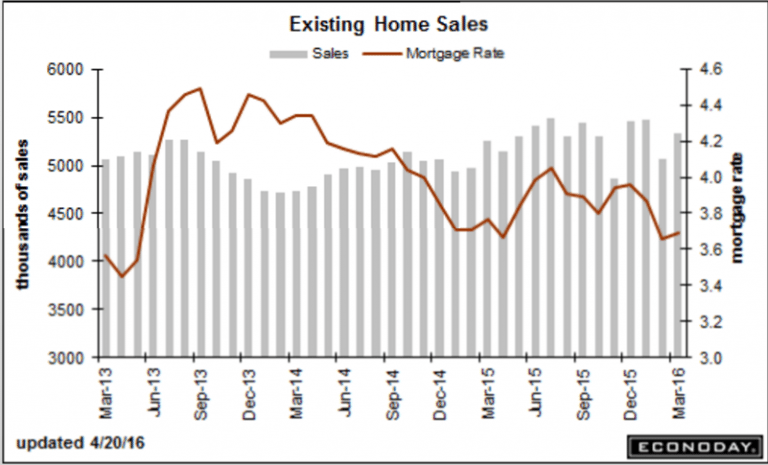
Existing home sales for March came in higher than expected up 5.1%.  This increase was led by SFRs  up 5.5% for the month to 4.76m.  The median price for existing homes is currently $222,700 falling short compared to 1 year ago when the median price topped out (for the period of this recovery) just above $230,000.

This means that interest rates neither encourage nor discourage borrowing. As human beings our propensity to take on long-term debt has nothing to do with what the interest rate is but rather it has everything to do with our employment outlook. So, until that changes the real estate market will continue at the same sluggish pace.

#gotrump


Wednesday, July 15, 2015

Banker In Heaven

Einstein dies and goes to heaven only to be informed that his room is not yet ready. “I hope you will not mind waiting in a dormitory. We are very sorry, but it’s the best we can do and you will have to share the room with others” he is told by the doorman.

Einstein says that this is no problem at all and that there is no need to make such a great fuss. So the doorman leads him to the dorm. They enter and Albert is introduced to all of the present inhabitants. “See, Here is your first room mate. He has an IQ of 180!”
”That’s wonderful!” says Albert. “We can discuss mathematics!”
”And here is your second room mate. His IQ is 150!”
”That’s wonderful!” says Albert. “We can discuss physics!”
”And here is your third room mate. His IQ is 100!”
”That’s wonderful! We can discuss the latest plays at the theater!”
Just then another man moves out to capture Albert’s hand and shake it. “I’m your last room mate and I’m sorry, but my IQ is only 80.”
Albert smiles back at him and says, “So, where do you think interest rates are headed?”

Saturday, May 30, 2015

Mike Norman Economics: It's Amazing How Close People Can Get To Simplicity, Before Irrationality Returns

Mike Norman Economics: It's Amazing How Close People Can Get To Simplicity, Before Irrationality Returns

Monday, June 30, 2014

Mike Norman Economics: Nick Edmonds — If Banks Don't Lend Reserves, What Do They Lend?

Mike Norman Economics: Nick Edmonds — If Banks Don't Lend Reserves, What Do They Lend?

Friday, September 20, 2013

Hold On To Your ARMs

I just finished up a call with a Mrs. Babikian who owns a home in Pasadena. She said she needs to refi her $310,000 mortgage.  

I asked:  What's the goal?
Mrs. B:  I want a fixed rate.

Me:  What's the rate you're paying now?
Mrs. B:  4.00% but it will adjust in 2015

Me:  Is it a fully amortized loan i.e. are you paying principal and interest?
Mrs. B:  Yes

Me:  Is the current payment affordable?
Mrs. B:  Yes

Me:  Contrary to popular belief you'll be better served with your current mortgage.
Mrs. B:  ????????
  
Me:  You have roughly a 70% equity position, you're paying down principal each month, it's a very affordable monthly payment, you don't need or want any cash... correct?
Mrs. B: Yes

Me:  The Fed has repeatedly stated that they will maintain the current target rate of 0%-.25% well into 2015.  While the Fed doesn't control mortgage rates their policy does influence trends for all other indexes long and short term.  This means when your rate adjusts it will adjust LOWER. 

Mrs. Babikian's mortgage is a 5/1 Libor ARM. Per the terms of her note the rate is fixed at 4.000% for the first 5 years and subject to change on April 1, 2015.

Section 4(D) of her note reads - 
The interest rate I am required to pay at the first Change Date will not be greater than 9.000% or less than 2.25%.  Thereafter, my interest rate will never be increased or decreased on any single Change Date by more than TWO (2.00%) from the rate of interest I have been paying for the preceding 12 months.  My interest rate will never be greater than 9.000%. 

Currently the 12 month LIBOR is .639% plus 2.25% margin and you get a fully indexed rate of 2.889%.  Pretty nice, huh?  

In light of what our Fed Chairman has been saying for the last 4 years and just said again two days ago, there's simply no reason to expect significant increases until at least 2018.  

Of course, many would argue that I'm giving bad advice rebutting with statements like  "Rates are artificially low right now."  and "It's not sustainable!"  

Like my Grammy used to say "Ahwww, you're pullin' my leg!"  Fact is, for a sovereign currency issuer it is totally sustainable.  Here's another fact - The natural rate of interest is zero.  


Tuesday, September 3, 2013

Choosing Between Adjustable Rate and Fixed Rate Loans: The Best Financial Decision May Surprise You

The most basic decision home buyers and home owners have to make is whether to choose a fixed rate loan or an adjustable one. It isn’t easy to break through media hype and find real data on which to make a sound, objective decision.  Unfortunately ARMs have been mostly prescribed as a way to afford a bigger home. 

A Short History
Americans have been regular customers of lenders selling fixed-rate loans since just after World War II. The fixed rate and payment provided a secure way for a growing middle class to achieve home ownership. Back then, adjustable rate loans as we know them today did not exist, so borrowers had little choice.

More recently, adjustable rate home loans have become widely available; however, they are still largely viewed with suspicion by a majority of borrowers. ARMs make up only 15-25% of all home loans funded in any given period. Many of these are actually hybrid loans that have an initial fixed rate period of 3-10 years. Borrowers with hybrid loans generally plan to refinance out of the loan when the fixed period ends, so they are really choosing a “short-term” fixed rate loan rather than a true adjustable rate loan.

The “Problem” with ARMs
The decision to choose an adjustable rate home loan over a fixed rate loan is a hard step to take for most people, for one reason: A fear of rising rates.  Many borrowers are old enough to remember, or have heard of, the Carter-era mortgage rates in the high teens, and most people think high inflation was to blame, and even though that's not how it works, this fear of the unknown motivates borrowers to choose the “safer” fixed rate alternative.
This decision is usually not in the best long-term interest of the borrower. It seems paradoxical, but in many cases choosing some sort of adjustable rate loan is actually the better financial decision. This is driven by two factors:
• The security of a fixed rate comes at a price (a higher rate compared to adjustable loans long-term).
• Over time, the interest rate risk of an adjustable rate loan diminishes, as the rises and falls of rates even out with the rhythms of the American economy.

 
The purported attraction of a fixed rate loan is security.  The lender assumes all the risk of changes in interest rates. That comfort comes at a price, however. On one hand, the borrower knows what his or her rate and payment will be for as much as thirty years. This price premium is, in effect, insurance that the borrower buys annually to have the lender assume the interest rate risk. Over the life of the loan, the cost of that insurance can add up:

Additionally, most (not you, of course) home owners that have owned a home for 10 years have a refi history that looks something like this:
  • 2002 - $300,000  30 year fixed 6.5% to lower monthly payment.
  • 2005 - $375000  20 year fixed 5,25% cash out at historically low rates.
  • 2010 - $350,000  20 year fixed 4.25% to lower rate and payment
  • 2013 - $327,000 15 year fixed 3.25% to save a ton of money in interest.
Average cost (whether out of pocket, out of equity or via a higher interest rate, I promise you, there's always a cost) per transaction: $4500 x 4 refis = $18,000.

Security? Only in an ideological sense.  


Tuesday, July 2, 2013

California Home Prices: A History

Saturday, May 4, 2013

CMG Financial - All in One

Tuesday, April 16, 2013

Back-Jack


made on Wondersay - Animate text with style

Wednesday, April 10, 2013

QE-shmooey

An early release of the Fed minutes caught me by surprise this morning. Not the "leak" in and of itself (DaRAHma!) but what the minutes revealed.  While Bernanke suggested tapping the brake pedal  on QE appears to be in order, the minutes tell us Fed members are not unified in this.  

Of everything I've read, Barry Habib offers the most intriguing take thus far.   Below is exerpted from this morning's Daily Update at www.MBSHighway.com.  

Within the Minutes, Fed members raised concerns that the jobless rate was elevated and that they are not confident of sustained improvement.  Remember, these Minutes were originally taken from the Fed Meeting prior to the most recent dismal Jobs Report.  Score one for keeping QE around longer.  On the other hand, there were several members who appeared to be in favor of the concept of a mid-year tapering down of QE purchases.  It looks as if the Fed is divided on when QE should begin to be tapered.
And speaking of the Fed and QE 3, supposedly QE 3 is defined by $85 billion in monthly Bond purchases.  This is supposed to be $45 billion of longer dated Treasuries and $40 billion of Mortgage Backed Securities (MBS) each month.   But swept under the rug is the fact that the Fed can reinvest principal – meaning that any MBS holdings that have been paid off, like individuals who are refinancing or principal payments, can be reinvested in buying MBS.  I think most would find it surprising that this amount actually exceeds the amount of buying they are supposed to be doing.  For example, last month, the Fed purchased their normal $40 billion in MBS plus an additional $45 billion.  This totals $85 billion in Mortgage Bond purchases.  So, when the Fed eventually gets around to using this tapering mechanism, we will need to listen to see if it includes reinvestment, because this figure can be very significant.  


Wednesday, January 23, 2013

Interest Rates, Thin Air, Ignorance and Treason


"In 1980 the national debt was only 800 billion but interest rates were at 20%.  Now.... the debt is nearly 16 trillion -20 times what it was in 1980! And rates?  Well, they're at zero."   -Mike Norman, John Thomas Financial Chief Economist


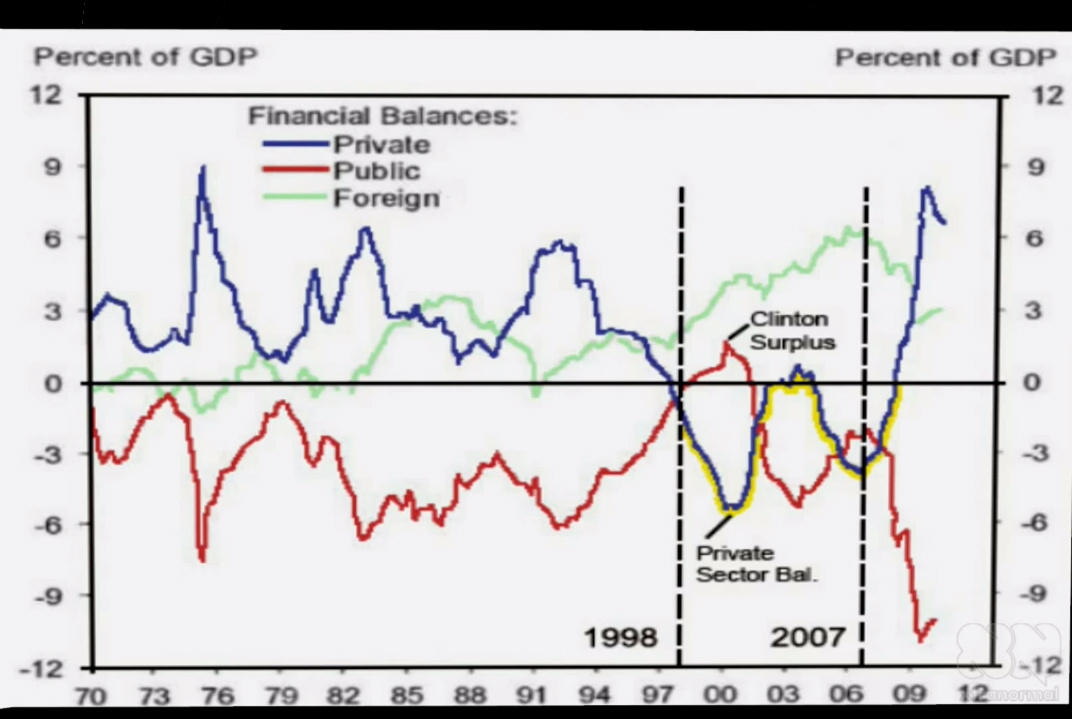
Clearly, deficits don't matter when you're the score keeper.  Modern money is tax driven.  Without taxation modern money has no value.  The U.S. dollar is modern money and it comes from "thin air".  So what happens to modern money when we pay Federal taxes?  It goes back where it came from - literally!  Dollars are spent into existence by decree of Congress.  The Federal government's liability is our asset and vice versa. Remember the Clinton surplus?


Every minute of every day the arbitrary number on the U.S. Debt clock is equal to dollars saved here and around the world, to the penny.  So, what's so unsustainable about consumers wanting to save dollars? Get a grip, people.  Stop listening to FOX, and CNBC and CNN and ABC and other mainstream sources because it makes you dumb!  Willful ignorance on this topic is an act of treason.


Saturday, April 14, 2012

New Benefit for Homeowners

The Administration has just announced a major expansion to the Home Affordable Refinance Program (HARP) in an attempt to help more homeowners by enabling them to refinance high loan-to-value mortgage loans at current low interest rates. The changes are effective immediately and tens of thousands of homeowners will be eligible for this new program.

To qualify for the enhanced HARP, the existing mortgage loan of a borrower must be owned or guaranteed by Fannie Mae or Freddie Mac with a current loan-to-value between 80.00 and 150.00 percent. The homeowner must also be current on the loan at the time of the refinance and must not have had a late payment on the mortgage in the past six months or more than one late payment in the past 12 months.

The most important enhancement to this program is the removal of the loan-to-value ratio cap for eligible mortgages. Originally, any mortgage that exceeded 125% of the value of the property was not eligible. Now the loan can exceed 125% of the value. This change makes tens of thousands of homeowners eligible to refinance at today's record low interest rates. Even better, Fannie Mae and Freddie Mac have eliminated certain pricing adjustments to make the refinances even more attractive.

Want to know if you are eligible for this great new program? I can help you by finding out whether your current loan is held by Fannie Mae and Freddie Mac as well as reviewing all of the qualification criteria. If you are interested in this free, no obligation review, call me!

Now you have an advocate in the mortgage arena.  Now you have a MortgageAngel!

Wednesday, October 5, 2011

Visualizing the U.S. monetary system

Wednesday, February 2, 2011

Compliments from Customers

"Jill,  I've talked to a number of brokers and none of them had a 5 year financing solution - except you!  Very admirable.  Thank you!"

- R. Moser, Marina Del Rey, CA

"It's been an unbelievable pleasure working with you, Jill.  Thanks for all of your help."
- M. Smart, Yorba Linda, CA

"Thank you for making our first home buying experience so pleasurable!"
- Brian and Haley M., Costa Mesa, CA

Monday, December 20, 2010

Merry Christmas, everyone!!

The Temptations - Silent Night


Tuesday, October 19, 2010

The Latest Mortgage Foreclosure Mess is just another Financial Crisis

Warren Mosler

Warren Mosler


The current mortgage crisis is not a real economic crisis.There have been no houses that have been actually destroyed - there has been no fire, no hurricane, or no earthquake damage. It's entirely a financial crisis, at least so far. So the government appropriate response doesn't include bulldozers, hammers and concrete. Just data entries into spread sheets in the Fed's computer.

The question is, are the authorities standing by with policy responses as needed to make sure it doesn't spill over into the real economy? To make sure people can still go to work, to grow food and to eat it, to build houses and live in them, to make shoes and wear them, to go hospitals and take care of sick people, to go schools and teach classes, to maintain the infrastructure of our country and to do cancer research?

Unfortunately the authorities are not doing any such thing. Therefore it all just might again needlessly/tragically spill over to the real economy, like it did in August 2008, when they let the last financial crisis spill over into the real economy, and from which we are only beginning to recover.
As I said then, and repeat once more, it's critically important to identify and punish the bad guys with a vengeance and alter incentives that support fraud. And it's even more important to not let the financial crisis spill over into the real economy by letting aggregate demand fall, sales collapse, and real jobs get lost. 

And today, as in August 2008, interest rate cuts and just about anything else the Fed might do isn't going to do the trick, and more likely will probably just continue to make things worse. Now, as then, and as always, an immediate fiscal adjustment is the needed silver bullet that restores demand. 

And now, as then, I continue to propose a full payroll tax (FICA) suspension which will immediately work to restore private sector aggregate demand, sales, and jobs. Private sector jobs are almost entirely a function of sales, directly or indirectly. Capitalism is driven by sales. When sales go up, jobs go up. A restaurant that's full doesn't lay anyone one off, no matter how much the owner dislikes the current tax structure, or the paper work. 

Public infrastructure spending can also a valid option. But it takes time, and it's ok to do both. Suspend FICA taxes and put in place desired infrastructure project funding, presumably in a well thought out basis with an eye to efficiency, and not in a blind rush to support aggregate demand.
So why is our government not standing by to suspend FICA taxes? 
And, even more pointedly, why haven't they already done so? Especially as it's a highly regressive punishing tax on the people we need and are hurting the most - the people actually working for a living who produce all the real goods and services that support our existence. 

Yes, it's the first deadly innocent fraud at work. The government thinks it needs those FICA revenues to be able to make Social Security payments. The problem is our elected Federal government officials do not understand actual monetary operations. If they did they'd recognize that the function of federal taxes is to regulate the economy and not to raise revenue. They don't understand the function of federal taxes is to simply take dollars away from us; it is not to give them what they need to spend. Their first clue should be that if we were to pay our taxes with old $20 bills they'd give us a receipt and then shred those $20 bills. Furthermore, is their not removing what's restricting aggregate demand (FICA taxes) so that normal spending patterns can resume getting something for nothing.
Instead, however, the deficit terrorists remain firmly in control. 
The best we can expect is for the decision makers not to raise taxes at year end when the tax cuts expire. There is no talk of actually lowering taxes for consumers, under any circumstances. 

Even the media's 'deficit doves' (who remain THE PROBLEM), agree that the 'long term deficits' are a problem, by pointing to interest rates as evidence that markets are currently willing to fund deficit spending, and talking about how austerity today is not the way to bring down deficits longer term. In general, they flagrantly violate 'Lerner's Law' (don't concede the principle) or what Lerner called 'Functional Finance' in the 1940's - government policy should target full employment and price stability regardless of whether it increased or decreased public debt, short term or long term.
So will this latest mortgage crisis hurt the real economy? Probably (and hopefully) not, best I can tell. It looks more to me like it's a potential transfer of dollars from banks and lenders with no propensity to spend to borrowers with high propensities to spend.
But I could easily be wrong. There is always the risk that it all somehow results in a further cutback in credit to the real economy. And while this potential drop in aggregate demand is easily offset by a simple fiscal response, the odds of our current gaggle of regulators and elected officials getting it right with an appropriate fiscal response seems slim and none.
John Maynard Keynes, after initially backing away from Lerner's 'Functional Finance' proposals, subsequently accepted them, writing: "[Lerner's] argument is impeccable, but heaven help anyone who tries [to] put it across to the plain man at this stage of the evolution of our ideas." 

I know the feeling!!!
Warren Mosler

Warren Mosler